Environment
We understand the importance of responsible environmental management and work to understand and carefully manage the impact of our operations.
Overview
OneSteel Manufacturing seeks to improve business sustainability by valuing environmental, social and economic considerations in our decision making.
Our sites operate under consents issued by the South Australian Government and regulated by the Environment Protection Authority and/or Department for Energy and Mining.
We work hard to minimise our impact, consistent with a continuous improvement philosophy, but we know that at times our performance will need to be improved. To this end we adopt a scientific and risk-based approach to environmental management, by understanding and minimising the effect of our operations on the environment. We seek continual improvement of environmental performance to address this, the efficient use of resources, and the minimisation or prevention of pollution.
Our Vision is to have a positive impact on our community, economy and environment by openly engaging our employees and stakeholders and delivering on our commitments. We welcome feedback and questions and appreciate and value the opportunity to engage directly with our communities.
Our operations are certified to the ISO14001 quality standard for Environmental Management and are audited annually by an independent third-party.
Environment Policy
We are committed to pursuing a high standard of environmental management throughout our operations and strive for continual improvement of environmental performance, the efficient use of resources, and the minimisation or prevention of pollution.
Air Quality
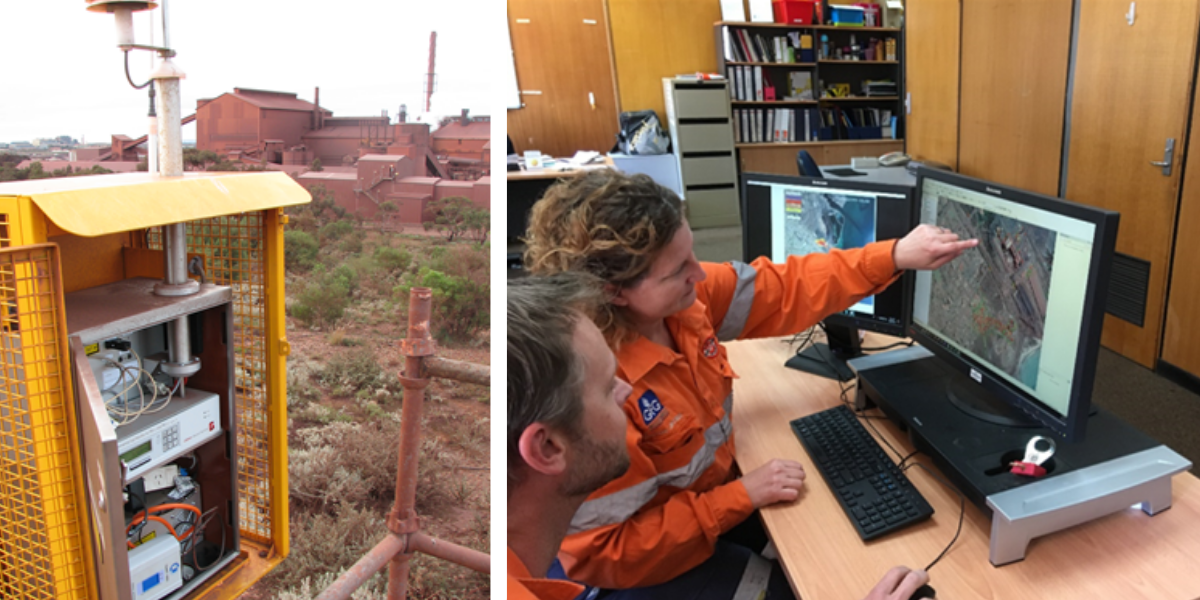
The Whyalla Steelworks is a large industrial facility which operates close to the community of Whyalla. As part of the operation, it is necessary to move large amounts of bulk materials into, around and out of the facility. This means that dust is a key environmental focus for the site. In mining areas dust is also a key focus, to minimise the amount of dust that could leave the operational areas and onto surrounding vegetation or property.
History
Historically, the Whyalla Steelworks had a material impact on the community of Whyalla through the effect of “red dust”, or red staining hematite, primarily from the Pelletising Plant, which makes pellets of iron ore, suitable for the Blast Furnace, and is located directly adjacent to the east end of Whyalla. In 2008, supported and encouraged by the community, “red dust” was significantly addressed through “Project Magnet” being the conversion of the Pelletising Plant to magnetite feed and to a wet process.
Ongoing focus
Due to the proximity of this large site to the community, dust remains a key priority for OneSteel Manufacturing. Significant effort is expended to continually improve by carefully measuring and assessing dust types and sources to prioritise controls and improvements.
A number of operational controls are used in Whyalla and in mining areas in the Middleback Ranges such as the use of both chemical dust suppression and water application to roads and stockpiles, fixed water sprays on transfer points on conveyors and discharge points and on ore fines in rail wagons, keeping some bulk storages of materials in enclosed sheds, the use of dust collecting equipment in processing plant and sheds, minimising speed limits on unsealed roads, the use of street sweeping equipment, and an operator- empowered dust ranking and action system.
Some recent areas of focus have been:
- closure of additional stockpile areas and increased water cart capacity
- upgrades to roadways and integration of dust suppressant
- use of water sprays
- Installation of monitoring cameras and equipment
The Whyalla Steelworks also has a number of stacks designed to lift emissions when they occur away from ground level and into the atmosphere to allow safe dispersion. OneSteel seeks to minimise these emissions and has strategic investment programs to achieve this.
Water Quality
The Whyalla Steelworks and the busy Whyalla Port operate in the beautiful False Bay on Spencer Gulf. The Gulf is the transport route into our site by ship for some of our raw materials, the route out for our iron ore products, some steel products, third party cargoes, and supplies cooling water for our operations. We take our responsibility in preserving the ecosystems in the Spencer Gulf seriously and have a comprehensive monitoring program to measure discharges and to assess the health of the receiving environment.
OneSteel Manufacturing’s water streams are treated and then released in a controlled manner into a buffer zone before final release to the marine environment. OneSteel Manufacturing reports regularly on a range of measurements to the South Australian Environmental Protection Authority (EPA).
Groundwater
OneSteel Manufacturing monitors the groundwater below its operations, both in Whyalla and the Middleback Ranges, to assess water quality and levels and these are reported regularly to the Environment Protection Authority and/or the Department for Energy & Mining.
Land management and cultural heritage
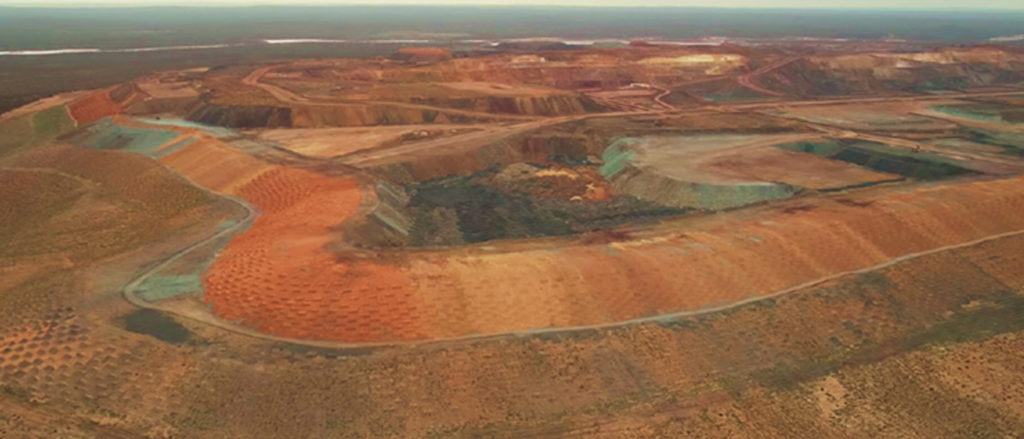
OneSteel Manufacturing holds approximately 300 mining tenements and has a duty to manage its custodianship of land responsibly and with care. One of the ways we seek to achieve this in the Middleback Ranges is through the Middleback Alliance, a long running partnership between landholders.
Middleback Alliance
The Middleback Alliance is a cooperative framework for sustainable land management across the southern Middleback Range and surrounding areas. The Alliance is directed by three major landholders in the region (Ecological Horizons, Landscaping SA Eyre Peninsula and OneSteel Manufacturing). Other landholders also participate by sharing resources and cooperatively delivering a works program across land boundaries. The Middleback Alliance delivers improved and sustainable land management outcomes. To date, 12 properties have participated over an area of more than 250,000 hectares.
OneSteel Manufacturing undertakes regular flora and fauna surveys and assessments around its operations and reports on these against baseline and control sites.

Significant Environment Benefit (SEB)
OneSteel Manufacturing has offset the impact of the vegetation clearance associated with its operations in the Middleback Range Mines and over the last 20 years this has been partly achieved by the establishment of the Ironstone Hill Conservation Park to the west of the Middleback Ranges.
Cultural Heritage
Protection of Aboriginal heritage is an important aspect of land stewardship which OneSteel takes very seriously. OneSteel Manufacturing has established protocols in place with the Traditional Owners of the land on which we operate, and before development occurs heritage surveys are conducted and documented. If work needs to take place near identified sites of significance, then in addition to internal controls and procedures, experienced monitors – appropriately authorised by Traditional Owners – are asked to be present during such works as an additional safeguard.
Resource use
OneSteel Manufacturing seeks to use energy, fresh water and other resources efficiently, including an emphasis on scrap metal recovery and recycling. Fresh water is regarded as a precious resource. Seawater used preferentially and reuse of fresh water is sought as far as practical. A number of waste streams of process water are reused in the process to reduce demand on the River Murray. Power use is minimised to the extent possible with waste process gases used for power generation and as a fuel source.
Lifecycle Perspective
OneSteel Manufacturing has adopted a life cycle perspective with respect to its operations and has processes and controls to minimise the impact, and maximise the sustainability, of its processes across the life cycle.
To support this perspective OneSteel Manufacturing has developed an EPD (environmental product declaration) for its steel products. Detailed information on how this EPD was produced can be found in the Methodology Report. This EPD provide detailed information about the relative environmental impact of different products at different stages of the life cycle.
Environmental sustainability
OUR DECARBONISATION PATHWAY
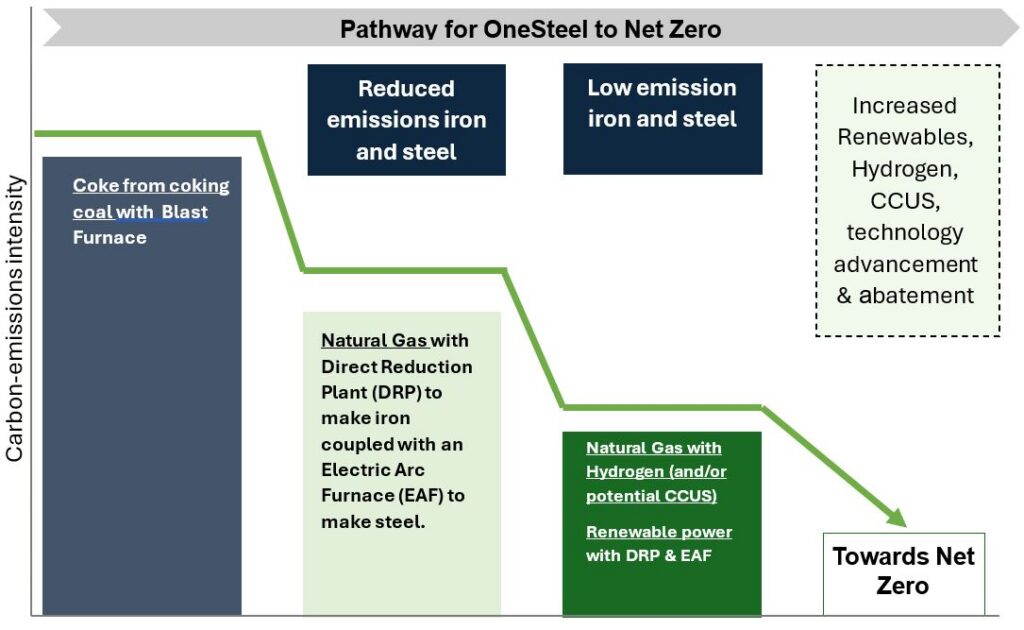
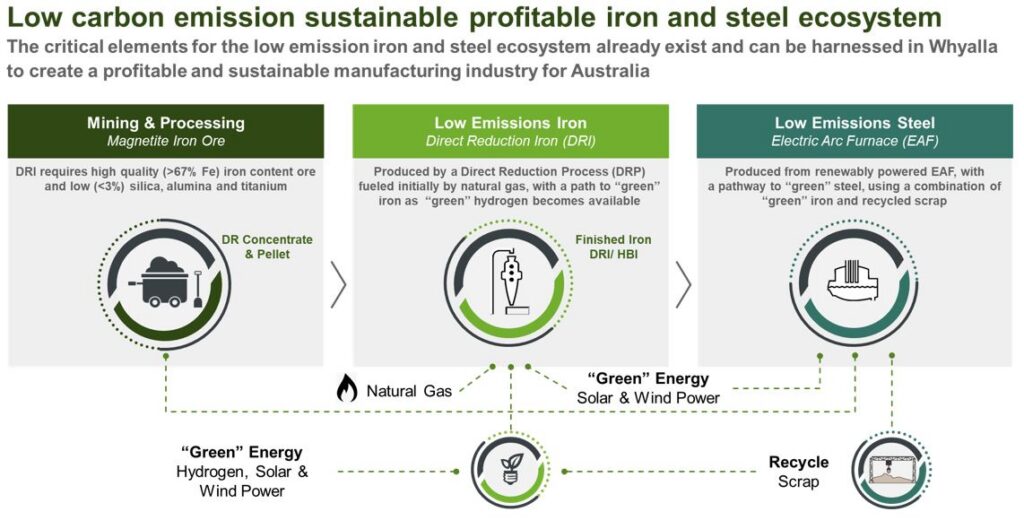
Whyalla presents a remarkable opportunity to transform an industrial manufacturing base to produce sustainable low-emissions iron and primary steel – a technology move that is also essential for the global steel industry.
The global steel industry accounts for approximately 7 to 9% of total global CO2 emissions. Steel therefore has an important part to play in reducing global emissions as the world moves towards net zero.
The world needs steel made from its primary ingredient of iron ore to produce high quality grades of structural steel to supply growing world demand for steel needed for infrastructure and development, and to supply the future scrap steel supply that come from end-of-life buildings and infrastructure.
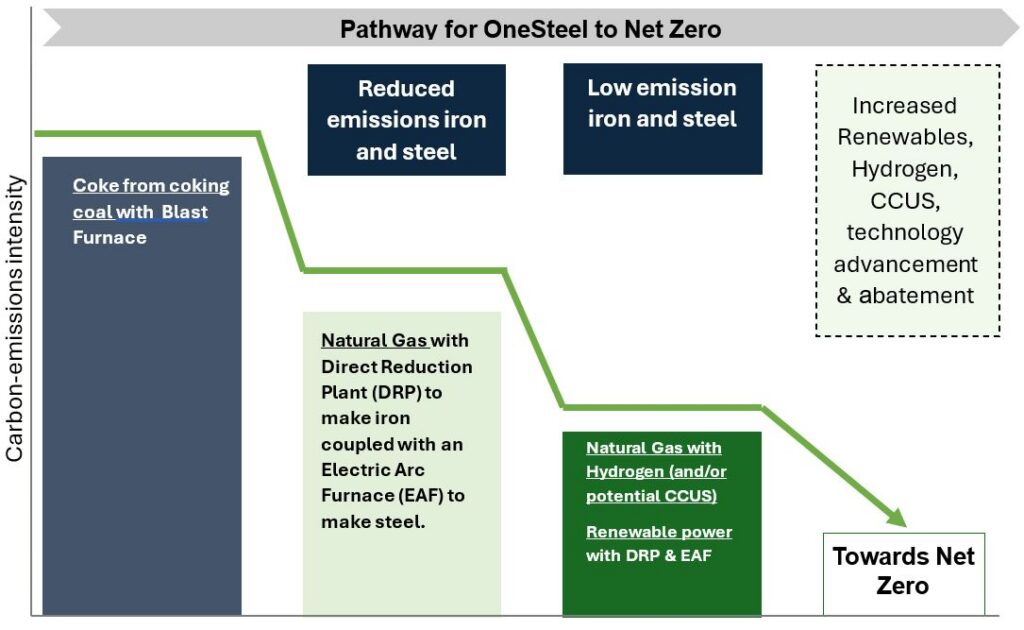
Traditional primary steel production typically uses coke (produced in coke ovens from metallurgical-coal) in blast furnaces to strip the oxygen from hematite iron ore. The use of coke result in higher carbon emissions. The decarbonisation of primary steel production is therefore critical to achieving global net-zero goals for the steel industry.
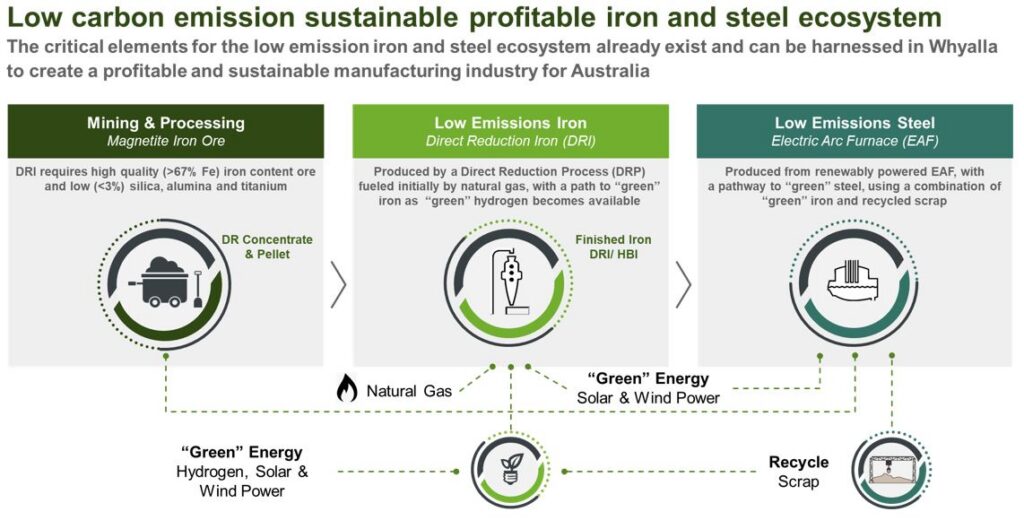
OneSteel’s Whyalla Steelworks in South Australia provides the perfect location to start this journey with high quality magnetite ore – an essential ingredient for green iron and steel production – a skilled mining and steelmaking workforce, a port with deep sea transhipment capability, ideal conditions for wind and solar power for renewable energy, a supportive community, and forward-looking state and federal governments.
Subject to decisions by a new owner, OneSteel Manufacturing Pty Ltd (Administrators Appointed) (“OneSteel”)is committed to pursuing a goal of net zero by 2050 for both its Scope 1 and 2 emissions using low-carbon emissions technologies for steelmaking, and aided by partial government funding.
The new owner of the OneSteel Whyalla Steelworks and magnetite mining assets in the Middleback Ranges has a generational opportunity to continue OneSteel’s pathway to net zero.
eNERGY AND eMISSIONS
Energy
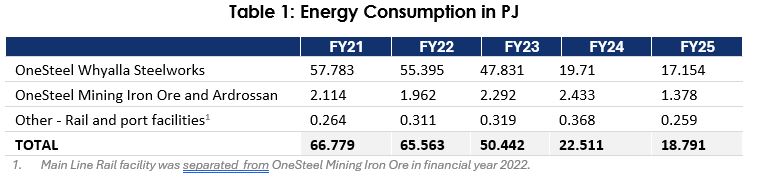
Energy is used across OneSteel’s facilities to produce iron ore, dolomite, pellets and steel. Energy sources include electricity, natural gas, diesel, LPG and other fuels. The energy used in the period spanning financial years 2021 to 2025 is shown in Table 1. Total energy consumption across all facilities declined over the most recent reporting periods, reflecting changes in operational activity, particularly at the Whyalla Steelworks facility.
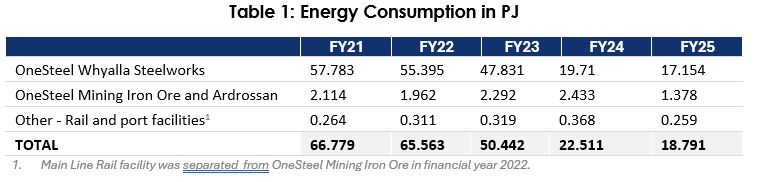
Across the five-year reporting period, the majority of energy consumed by OneSteel was associated with the steelmaking processes at the Whyalla Steelworks facility. While a range of fuels contribute to overall energy use, the energy profile is driven by the demands of iron and steel production. Process fuels such as coke and furnace gases make up most of the energy consumed, with electricity accounting for a smaller share. Electricity is supplied through a mix of onsite generation and grid‑sourced power, which includes both renewable and non‑renewable sources.
Greenhouse Gas Emissions
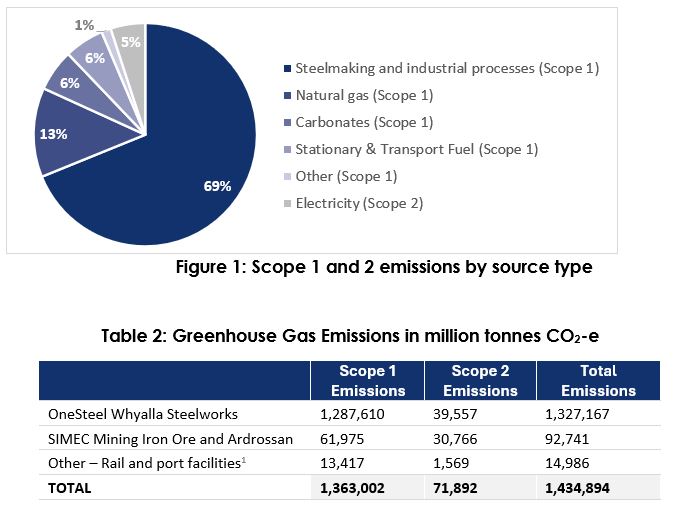
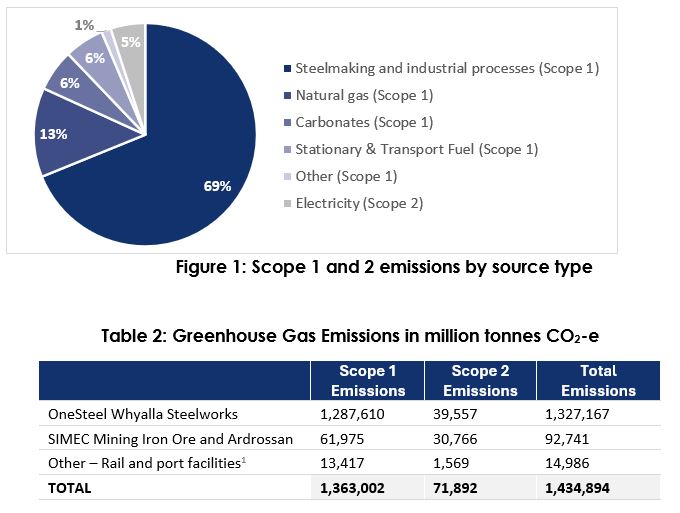
OneSteel’s greenhouse gas emissions are primarily from Scope 1 sources related to steelmaking and industrial processes, with additional scope 2 emissions attributed to purchased electricity.
The proportions and key sources of Scope 1 and Scope 2 emissions for financial year 2025 are shown in Figure 1, and a facility -level breakdown is presented in Table 2.
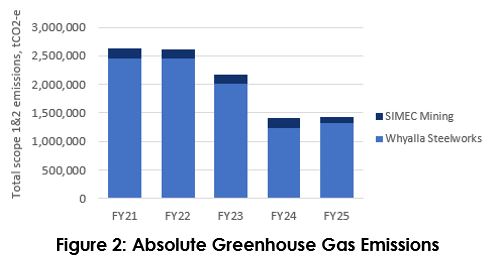
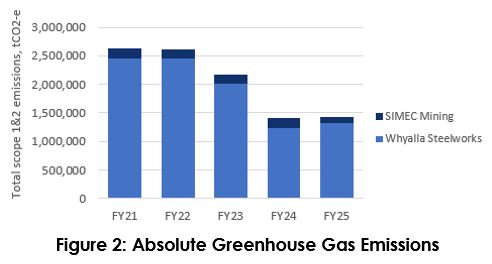
Total Scope 1 and Scope 2 emissions have declined over the reporting period in Figure 2, influenced by operational issues during the previous ownership period, which included extended periods of downtime.
OneSteel is seeking to implement a decarbonisation program using low-carbon emissions technologies, with partial government funding support and subject to decisions by a new owner.
Environmental sustainability
OUR DECARBONISATION PATHWAY
Whyalla presents a remarkable opportunity to transform an industrial manufacturing base to produce sustainable low-emissions iron and primary steel – a technology move that is also essential for the global steel industry.
The global steel industry accounts for approximately 7 to 9% of total global CO2 emissions. Steel therefore has an important part to play in reducing global emissions as the world moves towards net zero.
The world needs steel made from its primary ingredient of iron ore to produce high quality grades of structural steel to supply growing world demand for steel needed for infrastructure and development, and to supply the future scrap steel supply that come from end-of-life buildings and infrastructure.
Traditional primary steel production typically uses coke (produced in coke ovens from metallurgical-coal) in blast furnaces to strip the oxygen from hematite iron ore. The use of coke result in higher carbon emissions. The decarbonisation of primary steel production is therefore critical to achieving global net-zero goals for the steel industry.
OneSteel’s Whyalla Steelworks in South Australia provides the perfect location to start this journey with high quality magnetite ore – an essential ingredient for green iron and steel production – a skilled mining and steelmaking workforce, a port with deep sea transhipment capability, ideal conditions for wind and solar power for renewable energy, a supportive community, and forward-looking state and federal governments.
Subject to decisions by a new owner, OneSteel Manufacturing Pty Ltd (Administrators Appointed) (“OneSteel”)is committed to pursuing a goal of net zero by 2050 for both its Scope 1 and 2 emissions using low-carbon emissions technologies for steelmaking, and aided by partial government funding.
The new owner of the OneSteel Whyalla Steelworks and magnetite mining assets in the Middleback Ranges has a generational opportunity to continue OneSteel’s pathway to net zero.
eneRGY AND EMISSIONS
Energy
Energy is used across OneSteel’s facilities to produce iron ore, dolomite, pellets and steel. Energy sources include electricity, natural gas, diesel, LPG and other fuels. The energy used in the period spanning financial years 2021 to 2025 is shown in Table 1. Total energy consumption across all facilities declined over the most recent reporting periods, reflecting changes in operational activity, particularly at the Whyalla Steelworks facility.
Across the five-year reporting period, the majority of energy consumed by OneSteel was associated with the steelmaking processes at the Whyalla Steelworks facility. While a range of fuels contribute to overall energy use, the energy profile is driven by the demands of iron and steel production. Process fuels such as coke and furnace gases make up most of the energy consumed, with electricity accounting for a smaller share. Electricity is supplied through a mix of onsite generation and grid‑sourced power, which includes both renewable and non‑renewable sources.
Greenhouse Gas Emissions
OneSteel’s greenhouse gas emissions are primarily from Scope 1 sources related to steelmaking and industrial processes, with additional scope 2 emissions attributed to purchased electricity.
The proportions and key sources of Scope 1 and Scope 2 emissions for financial year 2025 are shown in Figure 1, and a facility -level breakdown is presented in Table 2.
Total Scope 1 and Scope 2 emissions have declined over the reporting period in Figure 2, influenced by operational issues during the previous ownership period, which included extended periods of downtime.
OneSteel is seeking to implement a decarbonisation program using low-carbon emissions technologies, with partial government funding support and subject to decisions by a new owner.